The Permission Ladder
A peer-reviewed study out of Cornell measured what happens when you make the identical small ask face-to-face instead of by email. The in-person version was 34 times more effective. Not 34 percent. Thirty-four times.
So why doesn't everyone sell everything in person? Because you can't walk up to a stranger's desk. The channels that convert best are exactly the ones you're least allowed to use, and that trade is the entire physics of outbound.
The ladder
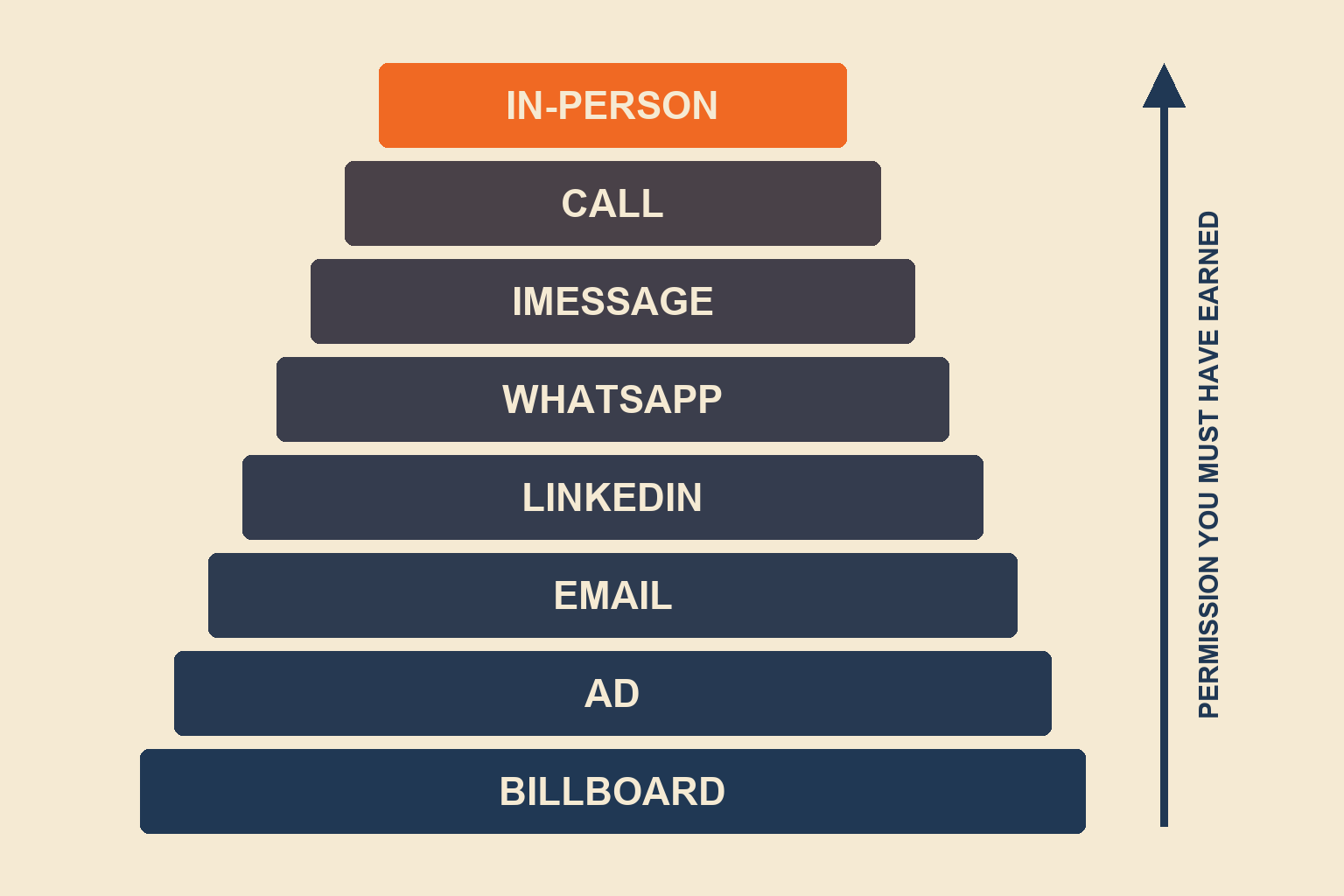
Line the channels up by intimacy: billboard, ad, email, LinkedIn, WhatsApp and iMessage, the phone call, the room. Response per touch climbs as you go up (the units shift from clicks to replies to conversations, so treat this as one gradient, not one metric). Display ads earn about 0.46% click-through. Strict cold email replies average 0.45%. LinkedIn connection requests get accepted 26–37% of the time. On the phone, only 2.3% of dials become meetings, but 65.6% of answered calls become real conversations. And at the top sits that 34x for asking in person.
Read it top-down and it says intimacy converts. Read it bottom-up and it says something more useful: the conversion you're drooling over is priced in permission you may not have.
The transgression tax
Every rung also carries a tax for arriving uninvited, and the tax climbs faster than the conversion does.
Nobody has ever felt violated by a billboard. Cold email is tolerated: annoying, deletable, legally an opt-out regime. But 80% of Americans no longer answer calls from unknown numbers. Seventy percent of US consumers have blocked a business's number outright. The FTC logged $470 million lost to text scams in 2024, five times the 2020 figure, which means your cold WhatsApp message competes with the scam prior in the recipient's head before any vendor comparison even begins. "How did you get my number?" is not a question. It's a verdict.
The law is the fossil record of this feeling. Email requires only an unsubscribe link. Cold texts in the US require prior express written consent, at $500 to $1,500 of statutory damage per message, with TCPA class actions up 112% year on year. WhatsApp doesn't even bother with nuance: Meta's policy bans cold outreach outright, and enforcement is a machine, roughly ten million accounts banned per month in India alone, over a million of them proactively before anyone complained. The platforms have automated the slammed door.
Buyers say the same thing when asked directly: 73% prefer email for a seller's first contact, and Gartner finds 61% would rather have no rep involved at all. The least intimate channel wins the first touch precisely because it presumes the least.
Enter where you're allowed, climb as you're invited
So the rule of the ladder: you may enter at the rung you've earned, and every rung above it must be granted, not taken.
A stranger has earned email, more or less. Reply in hand, you've earned the LinkedIn connection. A real conversation earns the phone number, used at an agreed time. Real rapport earns the text thread, and the text thread is where deals actually move, because the intimate channels convert like they do for the exact reason they're guarded. Skip the sequence and the same channel inverts: the WhatsApp message that reads as warmth from a known contact reads as home invasion from a stranger. Identical payload, opposite result, because the vector carries its own meaning.
This is also why bought phone numbers are such a false economy. The data vendor can sell you the number; nobody can sell you the permission that makes the number usable.
Founders selling into the US from elsewhere feel this hardest, because the trust deficit starts one rung lower: you're not just a stranger, you're a stranger from far away. The ladder still works. It just means the bottom rungs, done well, are your only honest entrance, and everything in this book about payloads exists to make those rungs earn the climb.
The exercise
Pull your last ten first-touches to net-new prospects. For each, write the rung you used and the rung you'd actually earned. Count the gap. Every touch launched two or more rungs above earned permission is a channel you're quietly burning, and the burn compounds: numbers get blocked, domains get flagged, accounts get banned, and none of those assets forgive.
This is a chapter of Right Channel, written in public, and its spine idea, that permission is the scarce asset, runs through everything else I'm writing. If you've seen a cold entry at a high rung work repeatably, not as a story but as a motion, I want the details. That would bend the chapter, and I'd rather bend it now than after it's printed.